
I am a big fan of Dr. Jason Fung, and I won’t mince words about it. His work on hunger and satiety, the root causes of obesity, and the practical application of fasting has heavily influenced both my training and my methodology as a health coach. I recently re-read his book The Hunger Code, and Chapter 8 really stood out to me. It dives into the pitfalls of hedonic hunger — the type of hunger tied to emotions, stress, pleasure, and habit rather than true physiological need.
The word “hedonic” simply means relating to pleasure or discomfort. In the context of eating, it refers to consuming food based on emotional or sensory reward rather than actual nutritional necessity. Most people immediately think of emotional eating as something connected to negative feelings like stress, depression, anxiety, anger, or loneliness. That certainly plays a role. But hedonic eating also includes celebration eating, boredom snacking, reward eating, comfort foods, and overindulgence during pleasurable experiences. In other words, it is not always sadness driving the behavior. Sometimes it is excitement, entertainment, habit, or simply chasing another dopamine hit.

Both sides of the equation can create excessive “food noise” — the constant mental chatter surrounding food — and over time, that can develop into deeply ingrained eating patterns and even food addiction, both physiological and psychological.
One of the most practical tools I have found for managing hedonic hunger is the combined use of mindfulness and Cognitive Behavioral Techniques (CBT). For simplicity’s sake, I like to refer to the combination as MCBT: Mindfulness Cognitive Behavioral Techniques.
Clinical research has shown encouraging results in this area. Mindfulness-based interventions have been associated with reductions in food cravings, emotional eating, and impulsive eating behaviors. CBT-based strategies have also demonstrated effectiveness in helping individuals interrupt automatic thought patterns and emotional responses tied to food. Together, these approaches help people create awareness between the trigger and the behavior instead of reacting impulsively in the moment.
But in plain English, here is what I think MCBT really does:
It slows down the conversation.
Most people today eat at full speed. We eat in the car. We eat while answering emails. We eat during meetings. We eat while binge-watching Netflix, doom-scrolling social media, gaming, or multitasking through three other activities at once. Eating becomes background noise instead of an intentional act.
That disconnected style of eating makes it incredibly difficult to recognize hunger and fullness signals accurately. The body may be trying to communicate satiety while the brain is too distracted to notice.
So the first step is surprisingly simple:
Stop.
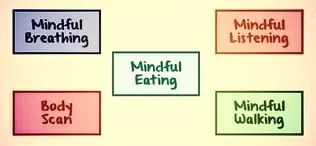
Turn off the distractions. Put down the phone. Silence the notifications. Shut off the TV. Step away from the computer. Make a conscious decision to focus on one thing for a few minutes: eating a discrete meal with intention and awareness.
Mindful eating can begin with something as simple as a moment of prayer, gratitude, or quiet reflection before the meal starts. That brief pause creates a transition point. It signals to the brain that you are becoming present and intentional instead of operating on autopilot.
Then, engage with the food using all five senses.
- Study it.
- What does the food actually taste like?
- How would you describe the texture or “mouth-feel”?
- Is it crunchy, creamy, chewy, tender, crisp?
- What aromas stand out?
- Does the food look vibrant and colorful, or dull and processed?
- Can you hear the crunch when you bite into it?
Most people have never truly experienced their food because they have trained themselves to consume it unconsciously.
The goal here is not perfection or obsession. The goal is awareness.
And if you are eating with someone else, engage with them. Have a conversation. Slow the pace of the meal naturally. Human connection itself can help reduce stress and emotional urgency around food.
This is important because satiety is not just about stomach volume. Hunger regulation is a sophisticated hormonal and neurological process involving stretch receptors in the stomach, signaling through the vagus nerve, and the release of hormones involved in fullness and appetite regulation. When we inhale food rapidly and mindlessly, we often override those systems before they have adequate time to respond.
Slowing down the eating experience gives the body time to communicate.
It allows digestion to function more efficiently. It gives hormonal signals — including natural satiety hormones like GLP-1 — an opportunity to activate properly. It helps the brain accurately assess fullness instead of continuing to chase stimulation and reward.
Hunger regulation is a sophisticated hormonal and neurological process involving stretch receptors in the stomach, signaling through the vagus nerve, and the release of hormones involved in fullness and appetite regulation.
At its core, the flow of MCBT for hunger control is fairly straightforward:
- Observe the craving.
- Acknowledge what you are feeling without judgment.
- Accept that the craving exists in the present moment.
- Pause long enough to create awareness.
- Then make an intentional, informed decision instead of an impulsive reaction.
That pause matters more than most people realize.
Mindfulness trains awareness of cravings without immediate action or self-condemnation. Instead of labeling yourself as “weak” or “undisciplined,” you simply learn to recognize what is happening internally. You become an observer rather than a prisoner of the impulse.
That shift is powerful.
Because once awareness increases, automatic behavior starts to lose control. You begin to regain your agency over your eating.
Research continues to support what many coaches and clinicians have observed anecdotally for years: mindfulness and CBT-based approaches can reduce emotional eating, decrease food cravings, and improve regulation of hedonic eating behaviors by interrupting automatic eating patterns and lowering emotional reactivity to food cues.
In a culture built around speed, distraction, convenience, and hyper-palatable processed foods, learning how to slow down may be one of the most underrated health skills a person can develop.
Not because food is the enemy.
But because unconscious eating often is.
If this resonates with you...
and you’d like to talk more about slowing down, reducing overwhelm, or creating healthier rhythms in life, send me a DM. I’d genuinely love to hear your thoughts.
Overcoming Emotional Eating